My New Student Won’t Talk… Is That Normal?
It’s 8:15 on Monday morning. A brand-new student walks into your classroom. They do not speak English. They sit down. They watch. They do not say a word. Not during the morning meeting. Not at lunch. Not even when you gently ask their name. By Wednesday, your teacher brain is working overtime.
Is something wrong?
Are they falling behind?
Should I call someone?
Am I supposed to make them talk?
Take a breath, friend.
I understand why you are worried because I have been there too. As an educator who has worked with English learners for many years, I have watched teachers welcome newcomers with the biggest hearts and then quietly panic when the student does not respond the way they expected. And let me be honest: I have had those same questions.
I wondered whether a quiet student understood me. I have questioned whether I was giving them enough support. I have looked at a student’s face and thought, “What do you need, and how can I help you when we do not yet share the same language?”
What you are seeing has a name. It is called the silent period, and it can be a completely normal part of learning a new language. Your student is not doing anything wrong. And neither are you. I Remember What It Felt Like I remember during my first year of teaching receiving a newcomer student who entered the classroom and barely spoke. I greeted my student each day. I smiled. I modeled words. I tried to create opportunities for the student to participate, but I received very little verbal response.
At first, I worried.
Was the student confused?
Was the student afraid?
Did the student understand anything I was saying?
Was I doing enough?
Then I began paying closer attention not just to what the student was saying, but to everything the student was doing. My newcomer started following classroom routines after watching the other children. My newcomer began pointing to familiar pictures. My newcomer responded to gestures, watched my face when I spoke and looked toward the correct classroom area when I gave directions. One day, I greeted my newcomer just as I had done every morning. This time, I received a small smile and a quiet response. It may not have seemed like a major classroom moment to anyone else, but to me, it was huge.
My newcomer student had been learning the entire time! The silence was not empty. My student had been listening, observing, processing, and slowly building the confidence to respond. That experience taught me something I want every teacher to know:
We cannot measure all newcomer progress by the number of words we hear. Sometimes, the greatest growth is happening quietly.
What Teachers Are Really Thinking
Let’s be real.
When you have never taught a newcomer before, the silence can feel alarming.
You care about your student. You want them to feel welcomed, but you may not know exactly what to do.
You may be thinking:
“What if my student is falling behind and I do not realize it?”
“What if the family thinks I am not supporting their child?”
“How will I know what the student understands?”
“What if I say or do the wrong thing?”
“Should I ask the student to repeat after me?”
“Am I supposed to make the student talk?”
I have heard these questions from so many teachers.
I have also felt that responsibility myself.
When a newcomer enters your classroom, you may feel like you are expected to have all the answers immediately.
But here is the truth:
You do not have to know everything on Day 1.
You do not have to speak the student’s home language to make them feel safe.
You do not have to create an entirely new curriculum overnight.
And you do not have to force your student to speak before they are ready.
Your student may be learning even when you cannot hear it yet.
Meet the Silent Period
The quiet stage many newcomers experience is called the silent period.
The silent period is a normal part of second-language development. It can last a few days for some students. For others, it may last several weeks or even a few months.
Every child is different.
A student’s age, personality, previous school experiences, comfort level, exposure to English, and experiences before arriving at your school can all affect how long this stage lasts.
But here is what I really want you to understand:
Your student may be silent, but their brain is busy.
They are listening to the way you pronounce words.
They are studying your facial expressions.
They are noticing how their classmates respond.
They are connecting your gestures to your words.
They are learning classroom routines.
They are listening for words they hear repeatedly.
They are quietly creating an internal map of how English works.
I often compare this stage to a sponge sitting in a sink filled with water.
From the outside, it may not look like anything is happening.
But underneath the surface, that sponge is soaking up everything around it.
That is what your newcomer may be doing.
They are soaking up sounds, words, expressions, routines, and social cues long before they feel ready to speak.
That silence is not empty.
That silence is full of learning.
When I understood this, it changed the way I looked at quiet students.
Instead of only asking:
“Why won’t this student talk?”
I began asking:
“What can I do to help this student feel safe while they listen, learn, and build confidence?”
That shift was a game changer.
What This Can Look Like in a Real Classroom
Picture this.
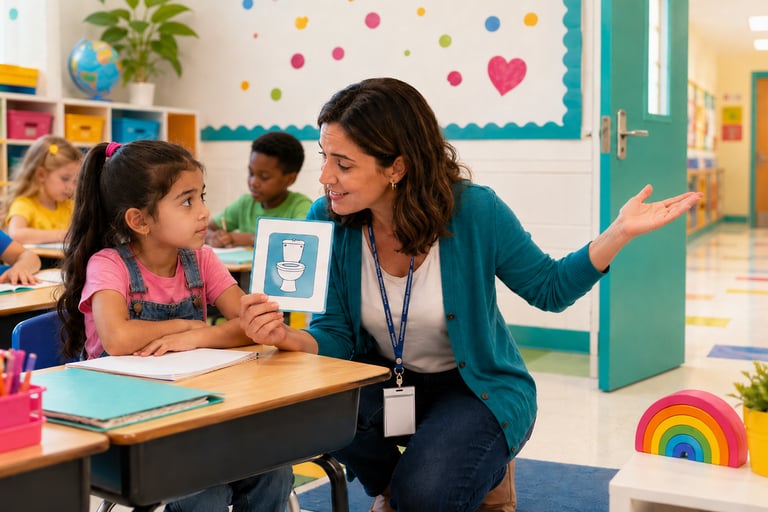
Zahra is a first grader who has just arrived at a new school.
She does not speak English yet, and almost everything around her
feels unfamiliar. Her teacher kneels beside her desk and shows her
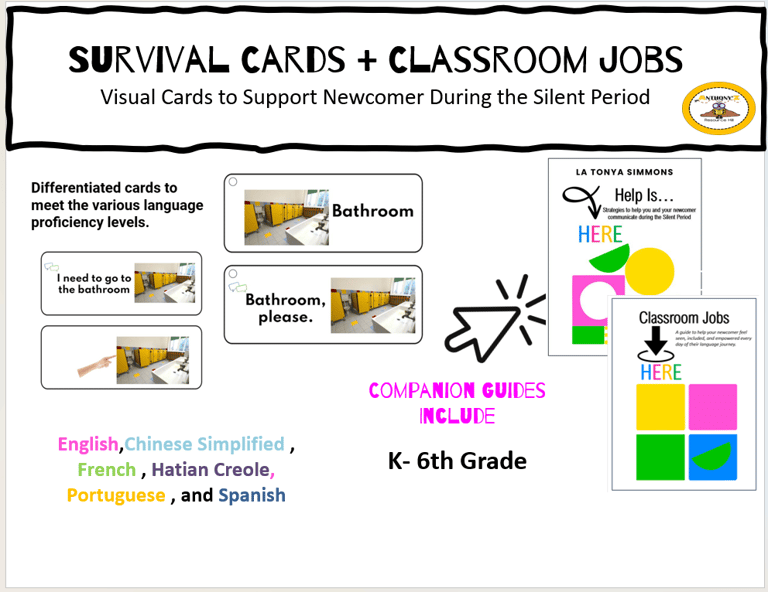
a small laminated card with a picture of a bathroom. The teacher
points to the card, gestures toward the classroom door, and then
points down the hallway. Zahra watches closely. Later that morning,
Zahra needs to use the restroom. She picks up the bathroom card
and holds it up. No translation app. No pressure to speak. No uncomfortable moment in front of the entire class.
Just one picture, one gesture, and one student who now knows how to ask for something she needs.
Before Zahra says a single word in English, she has learned something important:
I am safe here.
My teacher will help me.
I have a way to communicate.
I have seen moments like this happen with newcomers, and they remind me that we do not always need something complicated to make a meaningful difference.
Sometimes, one picture card can change a student’s entire day.
Safety first.
Speech later.
I know teachers mean well when they encourage a newcomer to speak.
We want students to participate. We want to hear their voices. We want to know they are learning.
But statements such as these can create more pressure than we realize:
“Come on, just try.”
“Repeat after me.”
“Say your name.”
“Use your words.”
Yikes!
Even with the best intentions, forcing speech can increase anxiety and make a student feel embarrassed or unsafe.
I have learned to invite students to participate without making speaking the only acceptable response.
Instead of asking:
“What did you do this weekend?”
I may show two or three pictures and allow the student to point.
Instead of asking:
“What do you want for lunch?”
I can show visual choices.
Instead of unexpectedly calling on the student, I can give them another way to show what they know.
Pointing
Matching
Drawing
Acting something out
Selecting a picture
Giving a thumbs-up or thumbs-down
Moving an object
Working with a trusted peer
Demonstrating a classroom routine
The goal is not to keep your newcomer silent.
The goal is to build enough safety, trust, understanding, and confidence that speaking begins to feel possible.
I Had to Learn to Look for Different Signs of Progress
As teachers, we are trained to listen for answers.
We ask a question, and we expect a verbal response.
But when I began working more closely with English learners, I had to adjust how I recognized progress.
I learned to stop waiting only for complete sentences.
Progress may look like a student:
Finding the correct classroom area without help
Following a routine after watching classmates
Responding when their name is called
Pointing to a visual schedule
Copying a gesture
Choosing the correct picture
Joining a classroom activity
Sitting near other students
Whispering one word to a trusted friend
Repeating part of a familiar song
Making eye contact and smiling
Attempting a new sound or word
Those are not meaningless behaviors.
Those are building blocks.
Celebrate them.
A student who begins pointing, nodding, following directions, or using a picture card is moving forward.
You may be witnessing the beginning of confidence even before you hear the language.
Why I Believe Every Teacher Needs a Simple Newcomer System
Over the years, I have seen what happens when teachers are expected to welcome newcomers without practical tools or a clear plan.
They scramble.
They search the internet during their planning period.
They create materials late at night.
They rely heavily on translation apps.
They worry that they are not doing enough.
And friend, teachers already have enough on their plates.
That is why I believe every classroom needs a simple system that is ready before a newcomer arrives.
Imagine having:
A visual classroom schedule
A welcoming peer buddy
Consistent gestures for classroom directions
Picture-supported routines
Simple greetings the student hears every day
Nonverbal ways to answer questions
A plan for communicating with the student’s family
When these supports are already in place, welcoming a newcomer no longer feels like an emergency.
You can move from panic to purpose.
You can confidently communicate:
“I may not speak your language, but I know how to help you feel safe, supported, and included.”
Let’s go!!!
Frequently Asked Questions About the Silent Period
Q: How long does the silent period last?
A: There is no exact timeline. Some students may begin speaking within a few days or weeks. Others may need several months before they feel comfortable speaking English at school. I encourage teachers to continue providing meaningful language, visuals, routines, encouragement, and opportunities to participate without pressure. Watch for progress in different forms, not only spoken words.
Q: Should I call on my newcomer during class?
A: Your newcomer should absolutely be included, but inclusion does not always have to require a spoken response. Allow your student to participate through pointing, nodding, drawing, gestures, picture choices, movement, matching, or working with a partner. I like to give students a way to opt in without placing them on the spot.
Q: Is my student falling behind because they are not talking?
A: Not necessarily. Silence alone does not mean a student is not learning. The student may be processing English, observing classroom routines, building vocabulary, and developing understanding long before speaking begins. However, I never recommend dismissing every concern as “just the silent period.” Look at the whole child.
If the student is not responding to visuals, gestures, routines, sounds, or communication attempts in any language, collaborate with your ESOL teacher and student-support team to determine whether additional support may be needed.
Q: Should I ask the student to repeat words?
A: You can model useful words and invite the student to repeat them, but do not force it. I model language naturally and consistently throughout the day. When students feel safe and ready, many will begin experimenting with sounds, words, and short phrases on their own.
Q: What can I do today to help?
A: Start small. Choose three to five visuals for the student’s most immediate needs:
Show the student how to point to or hand you the card. Then celebrate when they use it. That one simple step can give your newcomer an immediate way to communicate and give you both a little more confidence.
From One Educator to Another: You Are Not Failing
I want to leave you with this because I know how heavy the responsibility can feel.
You are not failing your student because they are not speaking yet.
You are not expected to know everything immediately.
And you do not have to transform your entire classroom overnight.
Start with safety.
Start with connection.
Start with a few visuals.
Start by greeting your student warmly every day even when they do not respond.
Your consistency matters.
Your smile matters.
Your patience matters.
The way you protect your student from embarrassment matters.
The way you celebrate one small nod, point, smile, or whispered word matters.
Your newcomer may not be able to tell you yet, but those actions are helping them understand:
I belong here.
You Do Not Have to Build Everything From Scratch
Whether this is your first newcomer or your fifth, you do not have to reinvent the wheel every time a new student enters your classroom.
Every child deserves to feel safe, included, and supported from the moment they walk through the classroom door.
And every teacher deserves practical tools that make that possible without adding hours of extra work to an already full plate.
I created the Help is Here Newcomer resource because I know what it feels like to want to support a student and not know where to begin.
I wanted teachers to have practical, ready-to-use tools they could pull out immediately, not another complicated program they would have to spend hours figuring out.
Inside, you will find visual supports, survival communication tools, classroom routines, and practical strategies you can begin using Day 1 of your newcomer student arriving.
Because welcoming a newcomer does not have to feel overwhelming.
With the right tools and a simple plan, you can help your student feel safe, seen, and supported from Day 1.
What Helped Me Support Quiet Newcomers
One of the most important lessons I have learned is that a newcomer does not have to speak in full sentences to communicate. When a student is in the silent period, focus on giving them ways to communicate without requiring speech. This is where visual support can make a huge difference.
A simple picture card for:
Bathroom
Water
Help
Hungry
Hurt
Yes
No
can give a student a voice before they have the English words to explain what they need.
They can point.
They can nod.
They can gesture.
They can hand you a card.
They can choose between two pictures.
They can follow the example of a trusted classmate.
I have seen the relief on a student’s face when they realize they do not have to struggle to produce a sentence just to ask for water or use the restroom. That makes my heart smile because a simple visual does more than communicate a need. It tells the student:
You are safe.
Your needs matter.
I am going to help you.
When a newcomer has a way to communicate, their anxiety can begin to decrease. And when anxiety decreases, participation often begins to increase. They may not be participating with spoken words yet, but please do not overlook the small wins. A nod is communication. Pointing is communication. Following a direction is communication. Choosing the correct picture is communication. Smiling when you greet them is communication. Sitting beside a peer during an activity is communication.
Comprehension often comes before verbal production. Your student may understand far more than they are currently able or ready to say.